Embelia ribes Burm.f.
| Etymology | Genus | From a Sinhalese common name of the plant |
|---|---|---|
| Species | After the genus 'Ribes or Gooseberries', referring to the fruit. | |
| Family | Primulaceae | |
| Synonyms | - | |
| Common Names | False Black Pepper, White-Flowered Embelia | |
| Status | Native: Least Concern | |
| Form | Woody climber | |
| Native Distribution | China, Indian Subcontinent, Southeast Asia, Papua New Guinea | |
Diagnostics
Embelia ribes is a woody climber found commonly in our secondary forests. The oppositely arranged leaves are elliptic to narrowly obovate, hairless and leathery; with indistinct veins, and pale green undersides. The petioles are slightly twisted. The berries ripen to a red colour.
Interesting Facts
All parts of the climber are used for traditional medicine or food (Silk, 2009). "The fruits or seeds are used as a vermifuge. In East Kalimantan, the crushed fresh bark is used to repel leeches and as a fish poison. The young leaves, shoots and young fruits are consumed as a (cooked) vegetable or condiment. The ripe sour-sweet fruits are also eaten as a delicacy, mostly by children."
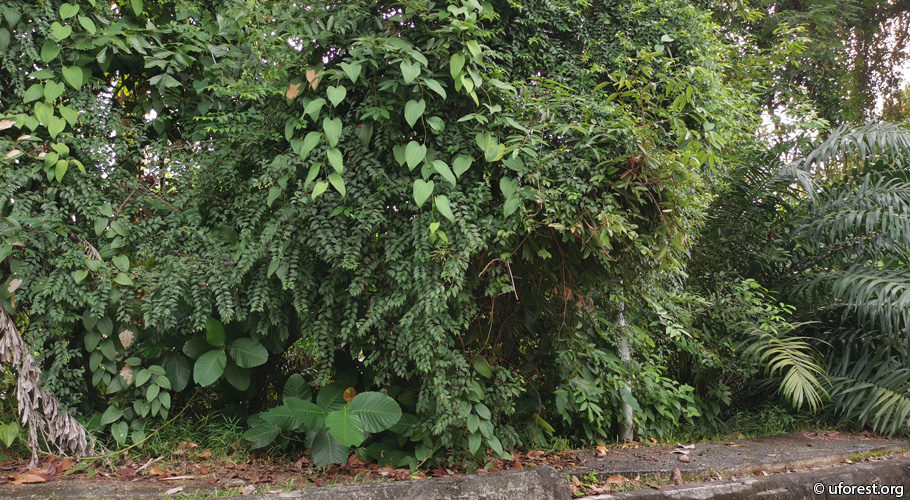
A sprawling cover of Embelia ribes at Kent Ridge Road (2020).
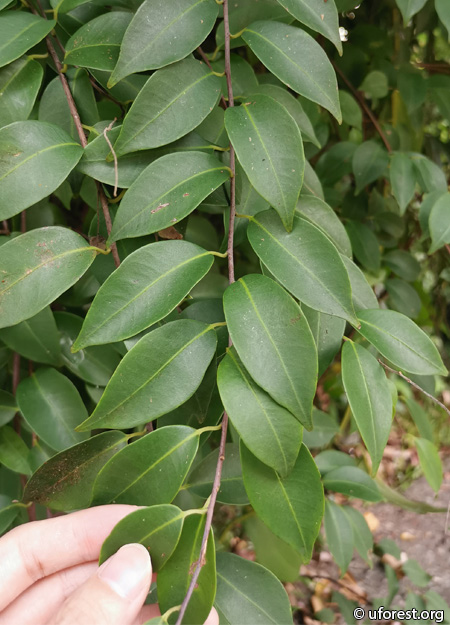
Neat opposite branching.
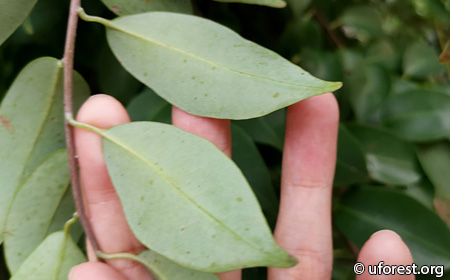
Pale green undersides of the leaves.
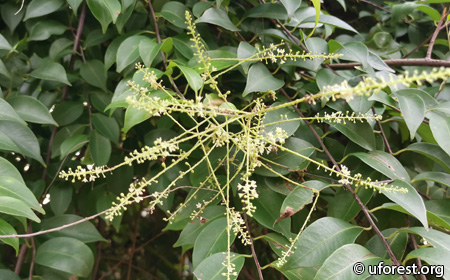
Inflorescence.
References
Slik JWF (2009 onwards) Plants of Southeast Asia. http://www.asianplant.net/Primulaceae/Embelia_ribes.htm.